
If you want to get better at your sport, coaches will tell you to work on things like your technique, strength, speed, and reps. All of these positively impact how you play, but what separates you when you train the same as all your teammates? There's a skill that decides how well all of that training actually shows up in a game, but nobody is going to tell you to focus on it.
That skill is confidence. And it’s one of the biggest things that separates good from great. And during a critical moment in a game, it works alongside all the hard work you put into physical practice like strength training and ball touches.
Let’s dive into why confidence matters on the court.
What Confidence Actually Does to Performance
In sports psychology, confidence has a more precise name: self-efficacy, your belief in your ability to execute a specific skill in a specific situation. A meta-analysis of 45 separate studies found a measurable relationship between self-efficacy and performance, with the average correlation landing at .38 across sports (Moritz et al., 2000). In behavioral research, a correlation of that size is significant. This supports that building confidence should be an important part in your training.
So what does it look like when players lack confidence? Self doubt easily clouds your head. Reaction time slows. Decisions get delayed. Recovery from a mistake takes longer and carries more emotional weight (Feltz et al., 2008). Confident athletes commit fully and let their training and instincts take over, and the difference shows up even when the skill level is identical.
Confidence Isn't the Reward for Playing Well. It's the Precondition.
Most athletes assume confidence shows up after success. That once you start performing well, you’ll never doubt yourself again. The research points the other way, and so does athlete experience. Confidence is what makes good performance possible in the first place, not what results from it. If you perform with the belief that you’re ready, you won’t doubt every little move you make
Michael Jordan built a lot of his public identity around this exact idea. In a well-known 1997 Nike commercial, he narrated his own missed shots and lost games. He's publicly cited missing more than 9,000 shots and losing roughly 300 games over his career, including 26 missed potential game-winners. The point was never the failures. It was his unwavering belief in himself and his ability to look forward to the next shot.
What Fear Actually Does to the Body
Anxiety doesn't just live in the mind. It can impact your physical performance too.
Researchers studied this in athletes recovering from ACL reconstruction. If you’ve ever gone through a major injury, you know how scary it can be when you’re finally allowed to do physical activity. They split 38 people who'd had ACL surgery into two groups (a high-fear group and a low-fear group) based on how much fear of reinjury they reported and compared both against a group of uninjured athletes as a baseline. Everyone performed the same test: a standardized jump-and-land movement, the kind of single-leg landing that shows up constantly in sports like volleyball. Using sensors that track muscle activation, researchers measured what their muscles were actually doing as they jumped.
The high-fear group's muscles fired differently than the low-fear group's, before the foot even hit the ground (Markström et al., 2022). Their bodies were already bracing, adjusting how they'd land, based on fear rather than on what the landing actually required.
If you apply this finding across all athletes, that explains a lot of hesitation in sports. A player thinking, even briefly, about the impact of a dive or the pain of a landing isn't performing at full capacity. Their body has already started protecting itself before they've consciously decided anything.
Protection and Confidence Don't Have a Simple Relationship
There's a well-documented phenomenon in behavioral research called risk compensation. When people feel protected, they don't just perform more confidently, they sometimes take on more risk than the equipment was ever designed to cover. In one study, people wearing a bicycle helmet, introduced to them only as a device to hold an eye tracker with no stated safety purpose at all, scored significantly higher on measures of risk-taking than people wearing a plain cap, even in a task the helmet couldn't possibly make safer (Gamble & Walker, 2016). The same effect shows up in contact sports. Research on football players has found that protective gear can measurably change playing behavior, sometimes encouraging harder or more reckless contact than an athlete would otherwise attempt.
Protection doesn't just neutrally hand an athlete confidence. It can shift behavior, for better or for worse.
What matters is what kind of confidence gear should actually be building. The goal isn't equipment that makes an athlete feel invincible enough to play recklessly. It's equipment that removes a specific, legitimate source of hesitation, like the anticipation of real, avoidable pain, without inflating false confidence about risks it was never meant to cover.
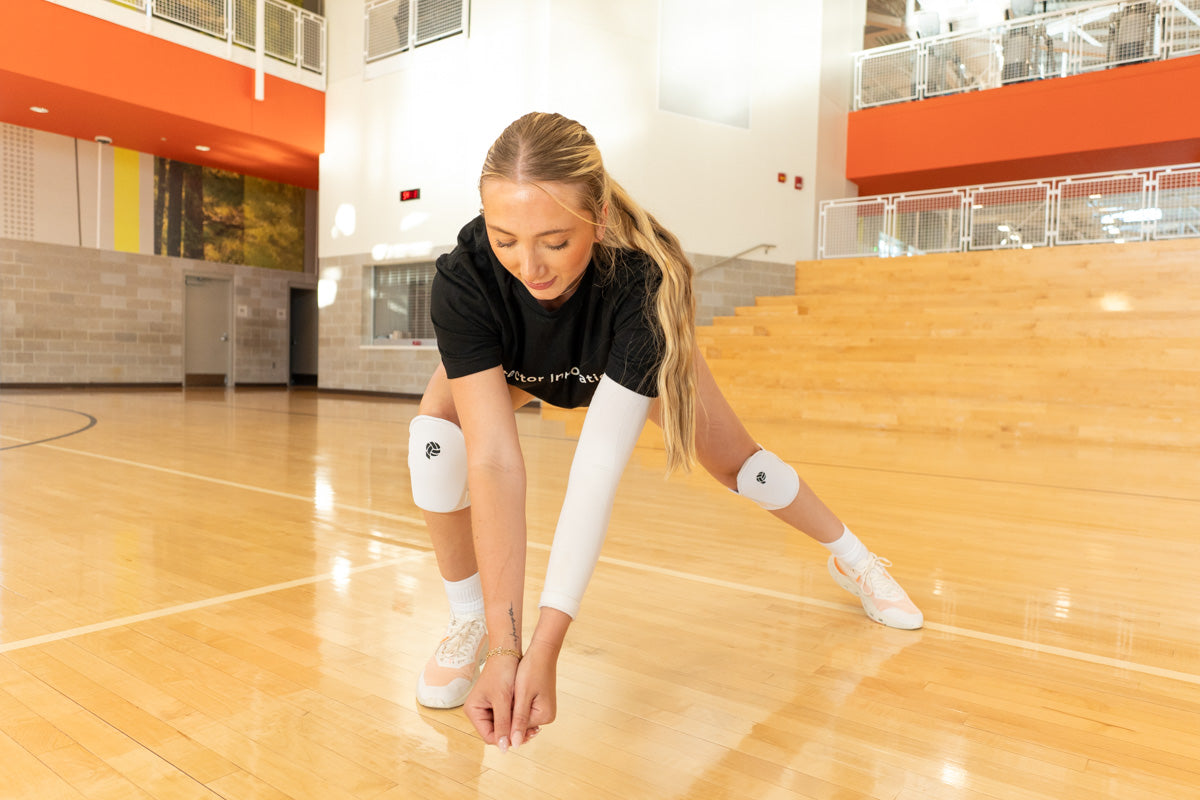
This is a big reason why we designed a better volleyball knee pad, the Patella Protector. With better protection on the knee and a more comfortable and snug fit, it’s gear that volleyball players can rely on. It removes the split-second thought about whether a dive is going to hurt in the same spot it hurt last time.
Where This Leaves Athletes
Confidence isn't something you're born with. It's built through preparation, repetition, and enough experience to trust your own execution under pressure. The environment around an athlete plays a real role too. By removing the specific, physical sources of hesitation that have nothing to do with skill, you can keep your focus on the game.
If you’re a volleyball player, this will sound familiar to you. If you have a knee that's still sore from last week's bruise, you could subconsciously make a split-second calculation of whether a dive is worth the landing, and that causes hesitation in a game where every millisecond counts. None of that is about talent. It's about whether your body is being protected properly. Confidence in your gear is just as important as self confidence.
Sources
Feltz, D. L., Short, S. E., & Sullivan, P. J. (2008). Self-efficacy in sport: Research and strategies for working with athletes, teams, and coaches. Human Kinetics.
Gamble, T., & Walker, I. (2016). Wearing a bicycle helmet can increase risk taking and sensation seeking in adults. Psychological Science, 27(2), 289–294. https://doi.org/10.1177/0956797615620784
Markström, J. L., Grinberg, A., & Häger, C. K. (2022). Fear of reinjury following anterior cruciate ligament reconstruction is manifested in muscle activation patterns of single-leg side-hop landings. Physical Therapy, 102(2). https://doi.org/10.1093/ptj/pzab218
Moritz, S. E., Feltz, D. L., Fahrbach, K. R., & Mack, D. E. (2000). The relation of self-efficacy measures to sport performance: A meta-analytic review. Research Quarterly for Exercise and Sport, 71(3), 280–294. https://doi.org/10.1080/02701367.2000.10608908