
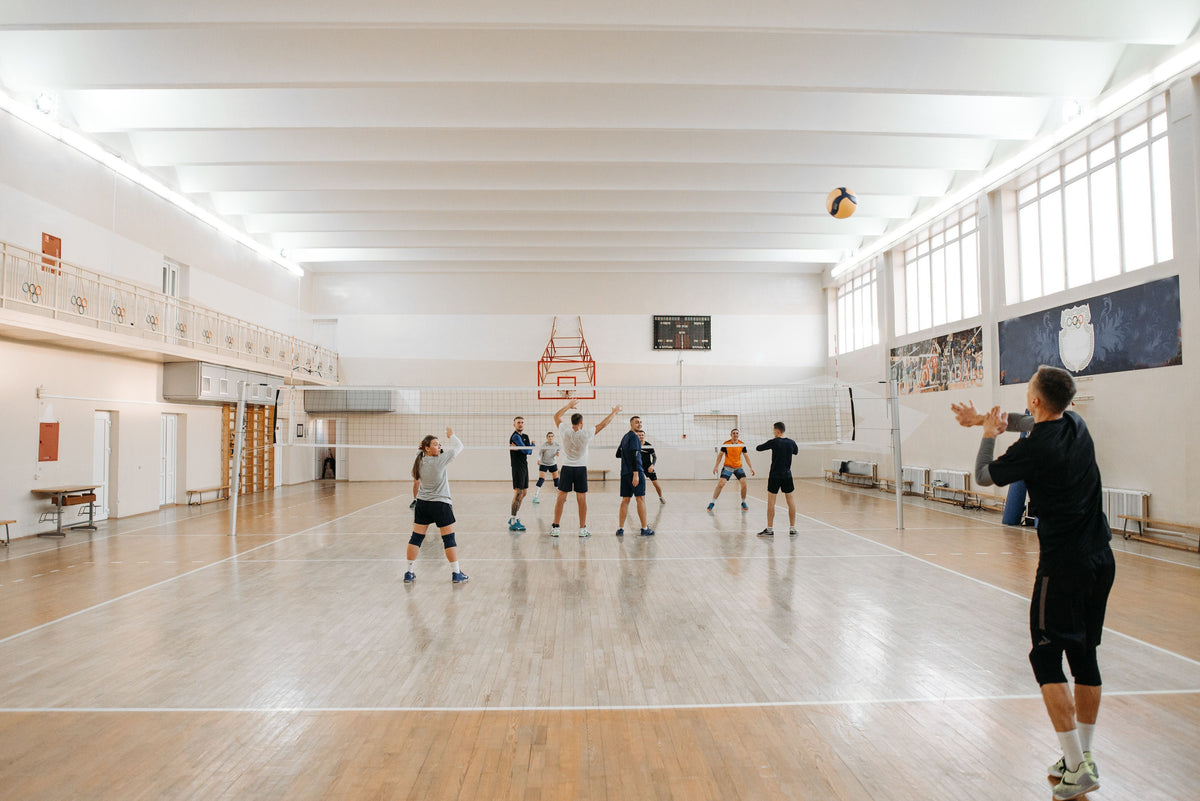
Most people assume that it’s easy to go from playing indoor volleyball to beach or grass. While it’s true that the core idea of the game never changes, there are slight differences that can catch you off guard.
These distinct rules, while seemingly insignificant, can have a major impact on how you approach the game. And if you start playing in tournaments, not knowing the differences could lead to unnecessary frustration and even cost your team points.
Indoor Volleyball
Indoor is the most structured version of the sport, and it's the one most people picture first. It's played on a hard court, six players per side, with an organized rotation and position system.
Each team gets three contacts to return the ball, usually as a pass, a set, and a hit. Blocking doesn't count as one of those three touches, which is what lets teams transition from defense to offense so fast. Players rotate clockwise every time they win a point on the other team's serve, and each spot on the court has a defined role: setter, outside hitter, middle blocker, libero, and so on. Sets are typically played to 25 points, and you must win by two. A full match is best of three or five sets.
The hard, fast surface calls for specific gear that outdoor volleyball doesn’t need. Court shoes with good grip matter for quick direction changes, and most players wear knee pads and elbow sleeves to handle the repeated floor contact that comes with defensive play.
Beach Volleyball
Beach volleyball is played on sand, almost always two players per side. Even though the courts are smaller than indoor, it's a more physically demanding version of the game. Endurance and all-around skill matter more than specialization. Especially because you’re running and jumping on sand.
There are a few key rules that change from indoor to outdoor. Blocking counts as one of the team's three touches in beach volleyball, which leaves only two touches left after a block. There's also no libero or specialized substitution system. Both players have to be able to pass, set, hit, and dig. Scoring changes too: beach sets are played to 21 points instead of 25, with a deciding third set to 15, still win by two.
The sand itself changes the gear. Most players compete barefoot, since the sand slows movement and cushions landings enough that traditional court shoes and protective gear aren't necessary, though sand socks are common in extreme heat or cold. The ball is different too. It's roughly the same weight as an indoor ball but slightly larger in circumference and made from a softer, textured material, which gives it a floatier feel in the air. Beach volleyball is popular in coastal cities, so weather is a huge factor and can even change over the course of one game.
Grass Volleyball
Grass volleyball is the least standardized of the three, though it's grown fast in recreational and tournament settings. It's typically played outdoors on natural grass and can range anywhere from two to six players per side depending on the event.
Grass sits in between the other two surfaces. It's softer than a hard indoor court but firmer than sand. Recreationally, people play barefoot, although some athletes opt for cleats or turf shoes for traction or if the terrain is uncomfortable.
Rules vary a lot by tournament. Usually players follow beach rules, including counting a block as a touch, but that's not consistent across events. It's worth checking the specific rules before competing rather than assuming.
Final Takeaway
Indoor, beach, and grass volleyball all share the same foundation, but it’s important to note the differences.
Indoor is structured and each position is specialized. Beach demands versatility and endurance from just two people covering a full court. Grass blends both, but rules vary based on who you play with. Understanding those differences ahead of time makes it easier to adjust to the rules.
At the end of the day, indoor, beach, and grass volleyball all require speed, communication, and a willingness to put your body on the line to make a play.
Sources
FIVB. (n.d.). Official volleyball rules 2025–2028. Retrieved July 2026, from https://www.fivb.com/wp-content/uploads/2025/01/FIVB-Volleyball_Rules2025_2028-EN-v05.pdf
NBC Olympics. (n.d.). Olympic beach volleyball rules: Overview, points system, serving, rally scoring, side change, hitting, net, timeouts. Retrieved July 2026, from https://www.nbcolympics.com/news/beach-volleyball-101-olympic-rules-and-regulations